

Selecting the appropriate delay analysis method is one of the most important steps in the preparation of a delay analysis.
The credibility of the analysis depends not only on the quality of the data but also on whether the selected methodology is suitable for the project conditions. There is no universally “best” delay analysis method. Instead, the appropriate methodology must be selected based on the particular conditions of each project.
The selection of a method should be driven by the facts of the case and not by the desired outcome. A well-executed analysis using an unsuitable method can still be challenged and disregarded.
One of the main considerations in method selection is the status of the project. Prospective methods, such as Time Impact Analysis (TIA), are generally more appropriate when assessing delays during project execution, where the purpose is to evaluate the expected impact of events on the remaining works. In contrast, retrospective methods are more suitable for completed projects, where actual progress data is available, and the analysis can examine what actually happened. Applying a prospective approach to a fully completed project often leads to unreliable results.
The quality and availability of project records is also an important factor. Reliable programme updates and contemporaneous progress data enable more detailed and reliable delay analysis.
The complexity of the project should also influence method selection. Large, complex projects with multiple interacting delays may justify a more detailed analytical methodology or approach.
A common mistake in delay analysis is the misapplication or inappropriate selection of the methodologies, such as using Impacted As-Planned on a completed project, mixing methodologies without justification or failing to consider the limitations of the available data. These errors can undermine the credibility of the analysis.
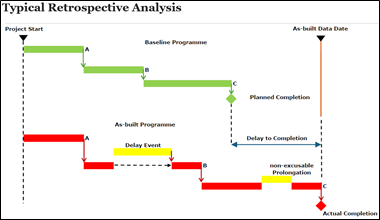
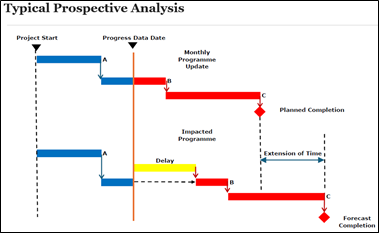
| Delay Analysis Techniques | |||
| Technique | Methodology | Requirements | Recommended Application |
|---|---|---|---|
| Prospective Technique | Impacted As-Planned | Logically Linked Baseline Programme | At the start of the project. If a delay occurred prior to the start of the project. |
| Time Impact Analysis |
|
During the course of the works to forecast the impact of the delay on the project completion. | |
| Retrospective Technique | Collapsed As-Built | Logically Linked As-Built Programme | When the project is complete. Used for sequential simple projects. Extremely difficult to apply to more complex projects when it is open to criticism. |
| As-Planned v As-Built in Windows |
|
When the project is complete. Can be employed on more complex projects where delays that occurred affect different paths during the course of the works. | |
| Retrospective As-Built Longest Path | As-Built Programme | When the project is complete. Used for complex projects to identify the factual critical chain of activities (the as-built critical path) that drives the project completion. | |
| Do’s and Don’ts When Selecting a Delay Analysis Method | ||
| Area | DO | DON’T |
|---|---|---|
| Project Status |
|
|
| Available Records |
|
|
| Baseline and Programme Integrity |
|
|
| Method Selection |
|
|
Choosing the right delay analysis method is not about preference or convenience, it is about selecting the approach that mostly demonstrates cause and effect which considers the circumstances of the project. When the methodology aligns with the available evidence and project status the resulting analysis is more likely to be defensible and robust.